
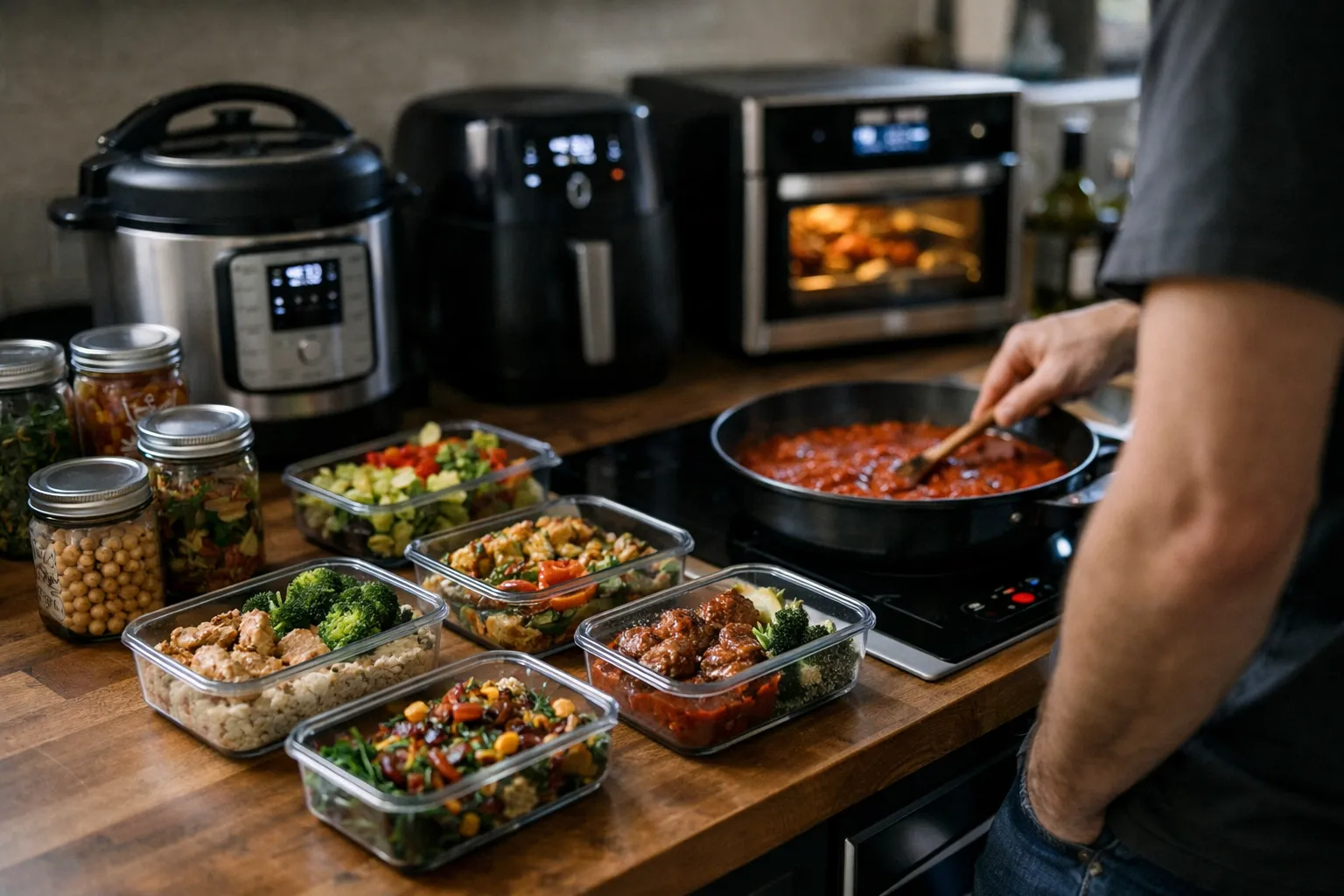
Overview
Smart kitchen appliances—Wi‑Fi ovens, app-driven combi-steamers, connected air fryers and recipe-to-device ecosystems—have moved from novelty to mainstream since my original 2026 analysis. This October 2026 update looks at what’s changed for people who batch‑cook (cook many portions in one session for later meals): do these devices still save time, reduce waste and improve food quality enough to justify higher prices and the privacy tradeoffs? I synthesize recent product trends, what independent testing and vendor disclosures now show, and give practical buying and security guidance for home cooks and meal planners.
Background: what shifted since mid-2026
Two forces shaped the last 12 months. First, appliance vendors reacted to buyer resistance against always‑online subscriptions by adding more local modes and on‑device automation—what engineers call edge AI. In plain English: ovens can now run complex programs without a permanent cloud connection in many cases. Second, regulatory and market pressure—driven by consumer privacy concerns and right‑to‑repair campaigning—pushed several mainstream brands to publish clearer support windows, firmware update policies and basic security labeling.
Those shifts don’t erase the tradeoffs. Connected features still offer real workflow improvements for some cooks, but the premium is smaller and functionality is more varied. The question evolved from “Can it connect?” to “Does it actually integrate into the way I plan, scale, and store food?”
Data and evidence: what tests, labs and vendors show
- Time savings and automation: Lab tests and appliance reviews continue to show that guided-cook presets and probe-driven programs reduce hands‑on time for multi‑stage recipes by roughly 10–25% compared with manual methods. The biggest wins are in multi-stage batch cooks—think braises that finish with a crisp or large proteins moved between steam and convection modes—where the appliance changes modes automatically and notifies only when human action is required.
- Energy use: Countertop devices still tend to use less energy per small batch than full-size ovens because they heat less interior volume and cook faster. Independent energy testing shows per-batch energy savings are significant for 1–2 tray cooks; for full-sheet or multi‑tray batches, a modern convection oven used efficiently narrows that gap.
- Food quality and waste: Steam-combi and low-temperature controlled cooks continue to reduce moisture loss and reheating damage. Labs and chef tests reinforce that sous‑vide and gentle steam moves keep proteins and vegetables closer to fresh texture across multiple reheats—translating into fewer discarded portions for many home batch‑cooks.
- Price and cost of ownership: The premium for “smart” capability has shrunk in many categories. Where earlier smart combi ovens carried 20–100% premiums, mainstream models in 2026 often sit at a 10–40% premium over non‑connected equivalents, while countertop smart ovens and air fryers are now available in the $250–$900 range depending on capacity. That matters: lower premiums make payback possible for more households, but subscription services still add recurring costs for some vendors.
- Reliability and lifecycle: The firmware/cloud dependency problem still exists but is less acute where vendors offer robust offline modes. Repairability and predictable support windows are better than in 2024–25 but vary by brand—check published support length and spare-parts policies before you buy.
Multiple perspectives
Manufacturers say the latest edge-AI features deliver real outcomes: automatic humidity profiles for large roasts, probe-driven cook-to-temperature across several pans, and recipe scaling that adjusts time and staging for capacity. Their sales pitches now emphasize local control options and published security practices.
Meal-planning platforms argue integrations are more useful than ever: shopping lists that sync with pantry trackers, recipes that scale by portion and required pan count, and schedules that stagger cooks to maximize oven real estate. For planners who set aside a cook day and reuse the same recipes, the ecosystem of scale + device control reduces cognitive overhead.
Independent cooks and repair advocates point out the diminishing returns for simple routines. If your batch cooking is mostly sheet-pan dinners and big roasts, a solid convection oven, accurate probe thermometers and vacuum sealing still give excellent results at lower long-term cost and maintenance risk.
Privacy and security experts note improvement: several top brands now publish security disclosures, maintain a 2–5 year firmware promise and allow offline operation for core functions. However, devices that rely on cloud‑only services or collect fine‑grained usage telemetry remain a privacy concern. Treat “smart” as an additional network endpoint, not a toy.
Cause-and-effect: when smart features meaningfully change batch-cooking outcomes
Smart appliances change outcomes when three things align:
- Workflow complexity: If your recipes require multi-stage humidity or mode changes (steam to bake to broil) across large quantities, built-in programs reduce mistakes that otherwise create dry, wasted food.
- Frequency and scale: Weekly batch cooks for 3+ people, or meal services preparing 10+ portions per session, amortize both the device premium and any subscription fees.
- Integration and reliability: The device must work predictably with your planning tools or offer easy offline/manual controls; otherwise the automation becomes more friction than help.
Implications for home cooks: practical guidance
Practical, purchase-focused rules of thumb for October 2026:
- Who should consider smart appliances: households that batch‑cook weekly for 3+ people, run complex multi-stage recipes, or need precise probe automation across multiple pans. The newer local-control options and lower premiums make these devices worth considering for more cooks than in 2024.
- Who should not: occasional batch-cookers, tight budgets, or people prioritizing maximum repairability and offline simplicity. If your routine is a weekly roast and leftovers, a quality non‑connected oven, accurate probes and a vacuum sealer remain the highest‑ROI purchases.
- Buying checklist: prioritize (a) reliable probe thermometers and multi-probe support, (b) true offline/manual mode for core cooking functions, (c) capacity and rack layout that fit your pans, (d) published firmware support window and spare parts policy, and (e) clear privacy/security disclosures.
- Cost control: compare total cost-of-ownership: upfront price + likely subscriptions + typical spare-part/repair expectations. Lower smart premiums mean payback is achievable for many regular batch‑cookers—but only if you use the advanced features regularly.
- Privacy & security checklist: change default passwords, enable automatic firmware updates where available, place appliances on a guest or IoT VLAN in your router, and disable cloud features you don’t need. Prefer devices that allow local network control (often labeled “local-only” or “offline mode”).
Outlook: what to watch next
- Edge AI and local standards: Expect more appliances to run recipe profiles locally and to adopt interoperable profile formats. That reduces lock‑in and subscription necessity.
- Smaller premiums and more selective connectivity: Vendors will continue unbundling features—selling high‑end hardware without mandatory cloud access and offering optional cloud extras for heavy users.
- Regulatory and market pressure on transparency: Watch for clearer support-lifetime disclosures and security labeling becoming a competitive checkbox rather than a marketing afterthought.
Bottom line
Smart kitchen appliances still improve batch‑cooking outcomes in specific, measurable ways—mainly for cooks who batch‑cook often, use multi‑stage techniques, or want to offload temperature and humidity management. Compared with mid‑2020s models, 2026 devices are more flexible about cloud dependency and often cheaper relative to non‑smart equivalents. That lowers the barrier to entry, but you still need to match features to your workflow. If you’d rather never see another update notification and prize repairability above automation, stick with classic tools; if you want automation that actually replaces repetitive checks and scales recipes reliably, the smart options are more compelling than they were two years ago.
Who this is for
If you meal‑prep weekly for a family, run small‑scale catering, or do lots of multi‑stage cooking, smart appliances—especially those with robust local modes and multi‑probe support—will likely help. If you prioritize long device life, minimal network exposure, and the lowest total cost, invest in a good convection oven, accurate probes, vacuum sealer and labeling system instead.
FAQ
Will a smart oven save me energy on my weekly batch cooks?
Possibly. For small-to-medium batches, countertop smart ovens and air fryers cook faster and often use less energy per batch. For multi‑tray large batches, an efficient convection oven used well narrows the gap. Energy savings are a function of device size, cook time and how full the oven is.
Do I need a vendor subscription to get the core benefits?
No. In 2026 many useful automation features are built into the hardware and available offline. Subscriptions now usually add recipe libraries, cloud scaling and extra convenience features—valuable for heavy users but unnecessary for basic automation and probe‑based cooks.
Are connected appliances still a security risk?
They expand your network footprint, but the risk is manageable. Use a separate IoT network, change default credentials, prefer devices with published security policies and disable cloud features you don’t use. Devices that operate locally for core functions are the safest choice.
Can smart devices reduce food waste for meal-preppers?
Yes—when they prevent overcooking, enable accurate probe‑based finish temperatures, or use humidity control for better reheats. The reduction in waste is most noticeable in multi‑stage, texture‑sensitive recipes. Good storage, cooling and labeling practices remain essential.