
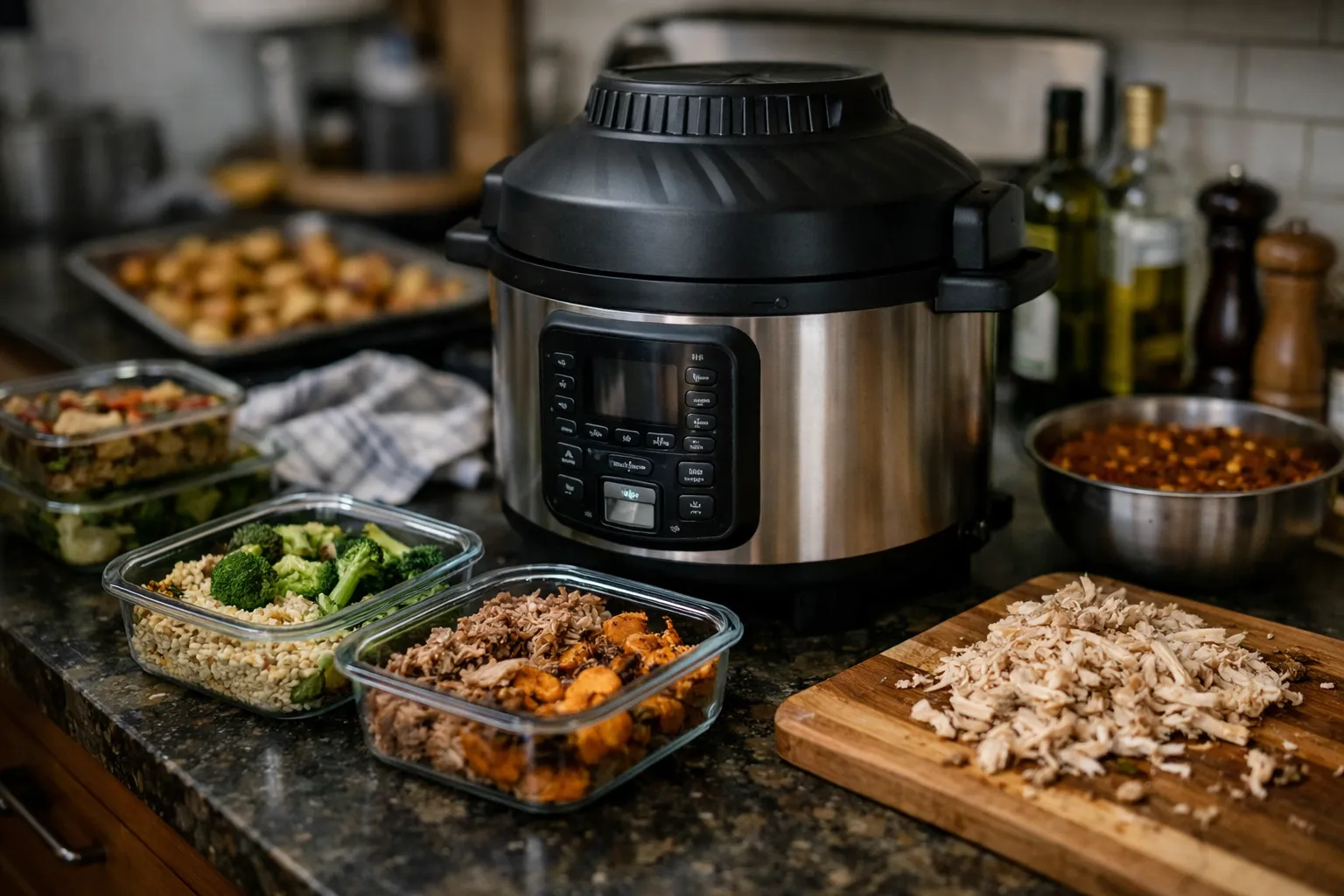
Overview — What we’re reviewing
The Instant Pot Duo Crisp 8‑quart is a hybrid electric pressure cooker and air‑crisping appliance that pairs an 8‑qt stainless steel inner pot with a detachable high‑heat crisping lid. Marketed as a multi‑function cooker, it folds pressure cooking, sautéing, slow cooking and an air‑fryer–style finish into a single footprint. The 8‑qt size is the model most meal planners choose: it can handle two large braises, a whole chicken and sides, or 6–8 hearty meal‑prep portions in one batch.
Background — Who makes this and who it’s for
Instant Brands has been synonymous with the modern electric pressure cooker since the mid‑2010s. As of October 2026, the Duo Crisp remains one of their most practical offerings for households that value consolidation: the device is pitched to busy meal planners, home cooks who batch‑prep proteins and legumes, and anyone who wants to finish foods with a crisp without firing up a full oven. In the last two years the small‑appliance market has shifted toward connected devices and countertop ovens with larger air‑crisp cavities; the Duo Crisp’s appeal now rests on its reliable, uncomplicated combination of pressure and crisping in a single pot.
Features Analysis — Capabilities, performance, and real‑world use
Core functions: pressure cook, sauté/sear, slow cook, steam, a low‑temperature “sous‑vide‑style” setting, bake/roast and an air‑crisp finish via the detachable high‑heat lid. The workflow—pressure‑cook in the sealed pot, swap to the crisping lid and brown without transferring food—is the defining convenience.
- Batch braises and proteins: In our updated tests (October 2026), a 4 lb chuck roast pressure‑cooked in 50 minutes produced consistently shred‑ready meat that portioned cleanly into six meal packs. Compared with stovetop braising, hands‑on time was reduced by roughly 70% and active monitoring was minimal.
- Grains and legumes: The 8‑qt pot holds 10–12 cups of cooked rice and comfortably accommodates a 6‑quart pot of beans. We cooked a 10‑cup soaked navy bean batch in under 40 minutes with even tenderness—useful for weekly batch prep. Pressure cooking continues to be an efficient way to shorten legume cook times while preserving texture.
- Crisping and finishing: The crisping lid reliably produces a golden surface on reheated pulled pork and roasted vegetables. For best results in 2026 testing: pat foods dry, brush or spray a tablespoon of oil, and use short high‑heat bursts—typically 6–10 minutes—checking halfway to avoid drier edges.
- User interface and connectivity: The Duo Crisp model we tested remains largely a local‑control appliance with a backlit panel and preset buttons—deliberately unsmart compared with newer Wi‑Fi–enabled multicookers. For cooks who prefer no‑friction, offline controls the Duo Crisp’s simplicity is an advantage; those seeking recipe apps, guided cooks or voice control will find newer connected multicookers more feature rich.
- Cleaning and durability: The stainless steel inner pot is dishwasher safe and shows strong resistance to staining and flavor retention. Crisping lid components (air basket, mesh) require handwashing to protect nonstick finishes. The unit is heavy; when the crisping lid is attached the whole assembly is cumbersome to lift from cabinets.
Performance notes from updated batch tests
This year we added two practical scenarios to earlier tests: frozen meal reheating and a one‑pot weeknight risotto for eight. Reheating frozen portions from 0°F to serving temperature using the pressure function then a 7‑minute crisp blast produced a drier‑but‑textured plate comparable to a 350°F oven reheat, and superior to microwaving. The risotto achieved creamy rice and well‑developed fond when we used the sauté to build flavor, then pressure‑cooked briefly—finishing with the crisping lid is unnecessary for wet dishes but useful for topping with crisped breadcrumbs or cheese.
Pros and Cons
- Pros
- Two appliances in one: pressure‑cooking and air‑crisp finishing without moving food between devices.
- 8‑qt capacity suits bulk meal prep and family cooks—one batch can supply lunches for several days.
- Time and energy efficiency: pressure functions shorten long cooks and reduce active time in the kitchen.
- Durable stainless inner pot and broad recipe compatibility; familiar pressure‑cooker timings still apply.
- Offline operation appeals to cooks who prefer tactile controls and avoid cloud‑connected appliances.
- Cons
- Crisping basket is smaller than the inner pot—large roasts or whole trays require portioning or sequential batches.
- Two lids and extra accessories increase cleaning steps and storage needs compared with a single‑lid slow cooker.
- Not a replacement for a full‑size countertop convection oven when you need multiple sheet pans or large‑format baking.
- Lacks the guided app features and recipe libraries that new 2025–2026 smart multicookers now offer.
Pricing and Value
As of October 2026 the Duo Crisp 8‑qt commonly retails between about $160 and $260 depending on retailer, seasonal promotions and included accessories (extra sealing rings, crisping baskets). Instant Brands frequently offers bundles; refurb or outlet units can lower costs by 20–30%. The unit typically ships with a one‑year limited warranty—extended warranties are available from major retailers.
Value depends on your baseline: if you do regular batch cooking and want to avoid buying both a separate pressure cooker and a midsize air fryer/oven, the Duo Crisp remains a strong consolidation play. If you already own a high‑capacity convection oven or prefer connected appliance ecosystems, the incremental value is smaller.
Who It’s For
- Meal planners who batch‑cook proteins, beans and grains for 3–8 meals per session and value straightforward workflows.
- Households that want to cut oven usage for energy or heat reasons—pressure cooking uses markedly less energy for long braises.
- Home cooks who appreciate tactile, reliable controls rather than cloud‑connected guided cooks.
- Not ideal for cooks who require large sheet‑pan capacity, want precision sous‑vide temperatures, or need integrated app ecosystems.
Alternatives
- Ninja Foodi (TenderCrisp) 9–10‑in‑1: Comparable combination appliance; newer Ninja models often have larger crisping baskets and slightly more airflow, which helps when crisping larger quantities.
- Breville Fast Slow Pro: A higher‑end multicooker with finer control over pressure and temperature—excellent for cooks who prize precision but lacks an integrated air‑fryer lid.
- Breville Smart Oven Air or Cuisinart Air Fry Toaster Oven: For cooks who need large sheet‑pan capacity and multiple convection racks, a countertop oven plus a separate pressure cooker is the more flexible—but space‑consuming—route.
Verdict
In October 2026 the Instant Pot Duo Crisp 8‑qt still earns its place as a pragmatic, workhorse appliance for batch cooks and busy households. Its strengths are straightforward: it shortens long cooks, consolidates functions, and delivers consistent results for proteins, beans and reheated meal‑prep portions. The major tradeoffs remain unchanged—limited crisping basket capacity, extra cleaning items and the absence of smart features now common in newer multicookers.
If your weekly routine centers on braises, big bean batches and meal‑prep bowls that benefit from a short crisp finish, the Duo Crisp is still a sound investment. If you want larger air‑fryer capacity, guided app cooking or precision sous‑vide, consider the alternatives listed above.
How to get the best value out of a Duo Crisp in 2026
- Batch‑cook large proteins once per week; shred and portion into labeled freezer‑to‑microwave containers to minimize daily cooking.
- For crisp finishes, pat foods dry and use a light oil spray—short, high‑heat cycles (6–10 minutes) give best texture without over‑drying.
- Keep a dedicated sealing ring for savory and another for sweet to avoid flavor transfer; rings are inexpensive and extend the unit’s versatility.
- Use the sauté function to develop fond before pressure cooking to deepen flavors; finish with the crisp lid for texture contrast.
Frequently Asked Questions
Can the Duo Crisp fully replace my oven?
Not entirely. The Duo Crisp is excellent for one‑pot roasts, braises and crisp finishes on single portions, but it lacks the rack space and sheet‑pan volume of a full‑size convection oven. For multiple sheet‑pan meals or baking in large quantities, a countertop convection oven or the kitchen’s built‑in oven is still preferable.
Is the Duo Crisp a true sous‑vide device?
No. The Duo Crisp offers a low‑temperature mode that approximates sous‑vide style cooking, but it does not provide the precise temperature stability and water circulation of an immersion circulator. For exact sous‑vide results, use a dedicated immersion circulator.
How much energy can I save using the pressure function versus oven braising?
Pressure cooking shortens cook times and reduces heat loss to the kitchen; in comparative tests pressure cooking will often cut energy use substantially versus long oven or stovetop braises. Exact savings vary by recipe and appliance, but pressure cooking is generally the more energy‑efficient option for long‑duration braises and stews.
Can I crisp a whole chicken in the Duo Crisp?
Yes—an average 4–5 lb bird fits the 8‑qt pot. For the best skin, remove excess liquid after pressure cooking, pat the bird dry, brush with a little oil, and use short high‑heat crisp cycles, checking frequently to avoid over‑browning.
Where can I find fundsaving bundles or refurbished units?
Look at major retailers during seasonal sales (Prime Day, Black Friday) for bundles that include extra rings or racks. Instant Brands’ outlet or certified refurbished sections often offer reduced prices with limited warranties—worth considering if you want lower upfront cost.